
Preclinical and Late-Stage Process Development
By integrating optimized synthesis, efficient purification platforms, and proactive scale-up risk assessments, we compress development timelines and prevent costly late-stage delays while significantly reducing your overall Cost of Goods (COGS).
Preclinical Support

Synthesis optimization and Key Analytics
- Maximize reaction yield
Dramatically reduces raw material consumption and per-batch costs, improving overall process economics.
- Optimize enzyme loading & raw material selection
Targeted selection of critical raw materials and precise enzyme loading lowers cost-per-batch while improving consistency.
- Minimize impurities
Reducing impurity profiles upstream eases the burden on downstream purification steps, increasing throughput and yield recovery.
- Build key analytical capabilities
Expert guidance on identifying and implementing the right analytical tools to guide optimization, characterize impurities, and maximize yield.
Process Optimization
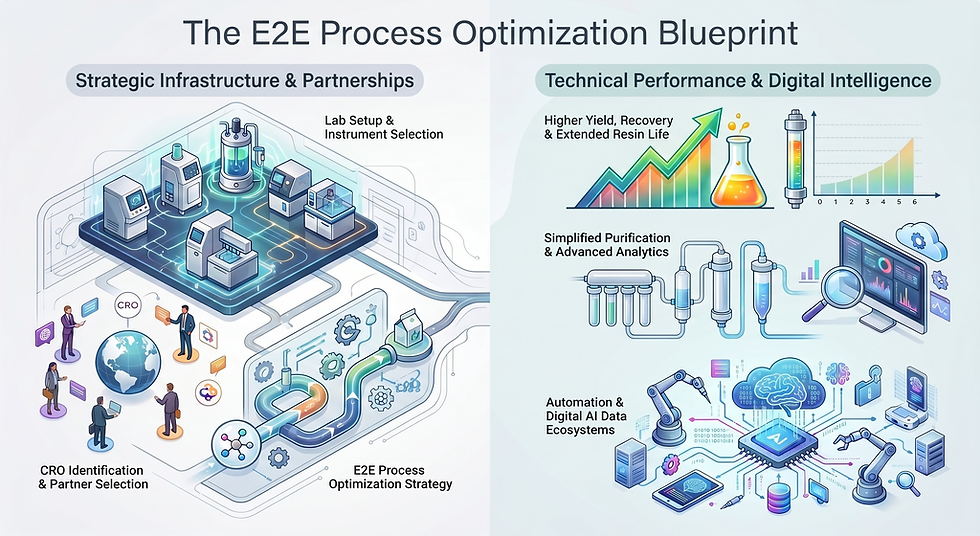
- Higher yield & recovery — smaller batches, lower costs
Optimized purification yield and recovery directly reduce the upstream batch size needed to hit output targets — creating a multiplicative reduction in raw material consumption, labor, and facility overhead.
- Extended chromatography resin life
Strategies to prolong resin lifetime across more purification cycles - significantly reducing one of the highest recurring costs in downstream processing without compromising product quality.
- Simplified purification step design
Reduction in the number and complexity of purification steps to cut processing time, minimize product loss at each stage, and lower the risk of batch failure.
- Lab setup & instrument selection
End-to-end guidance on building your laboratory from the ground up - from equipment selection and layout to instrument procurement - ensuring your infrastructure is fit-for-purpose from day one.
- Automation & digital AI strategy
Strategic advisory on integrating automation and AI-driven tools into your bioprocessing workflow — reducing manual variability, accelerating decision-making, and future-proofing your operations.
- CRO identification & partner selection
Independent, unbiased guidance on identifying and evaluating contract research organizations — matching your specific program needs, timelines, and budget to the right external partners.

Late-Stage Process Development
- Proactive scale-up risk assessment
Scale-down modeling and early risk identification catch manufacturing issues before technology transfer — preventing clinical holds and regulatory delays that typically set programs back 12–18 months.
- Establish a scalable process early
Designing for scalability from the outset eliminates the need for costly, disruptive late-stage process redesigns that can derail timelines and budgets.
- Process robustness studies
Structured studies validate process performance across parameter ranges, building the evidence base required for regulatory submissions and reliable manufacturing.
- Toxicology material generation guidance
Expert support for planning and executing tox batch manufacturing, ensuring material quality and availability aligns with preclinical study timelines.
- CDMO identification & GMP readiness
Strategic guidance on selecting the right manufacturing partner and preparing a GMP-ready process package, accelerating the path to first-in-human studies.
- Comprehensive risk identification
End-to-end risk mapping across the development and manufacturing lifecycle, providing a clear mitigation roadmap to protect program timelines and investment.
Frequently Asked Questions
What are the main goals of your synthesis optimization services?
Our reaction optimization simultaneously focuses on improving purity and yield while reducing costs and the generation of impurities. We also provide expert guidance on biocatalysis, enzyme kinetics, and optimizing enzymatic processes across various protein classes to ensure a robust and scalable process from the start.
Which chromatography and filtration techniques do you utilize for Downstream Process (DSP) optimization?
We design highly efficient purification platform strategies by utilizing affinity, ion exchange, SEC (Size Exclusion Chromatography), mixed-mode chromatography, and TFF (Tangential Flow Filtration) to maximize both product recovery and purity.
How do you mitigate risks when transitioning a process to larger manufacturing scales?
We perform thorough scale-up risk assessments to pinpoint specific process parameters that may behave differently at larger volumes. Furthermore, we advise on development of scale-down models to effectively troubleshoot any issues that arise during this transition.
Do you assist with early-stage regulatory and quality planning during scale-up?
Yes, we provide expert advice on process characterization, which directly leads to the drafting of your initial Quality Target Product Profile (QTPP), bridging gaps from early-stage activities to the clinic/ IND stages.